

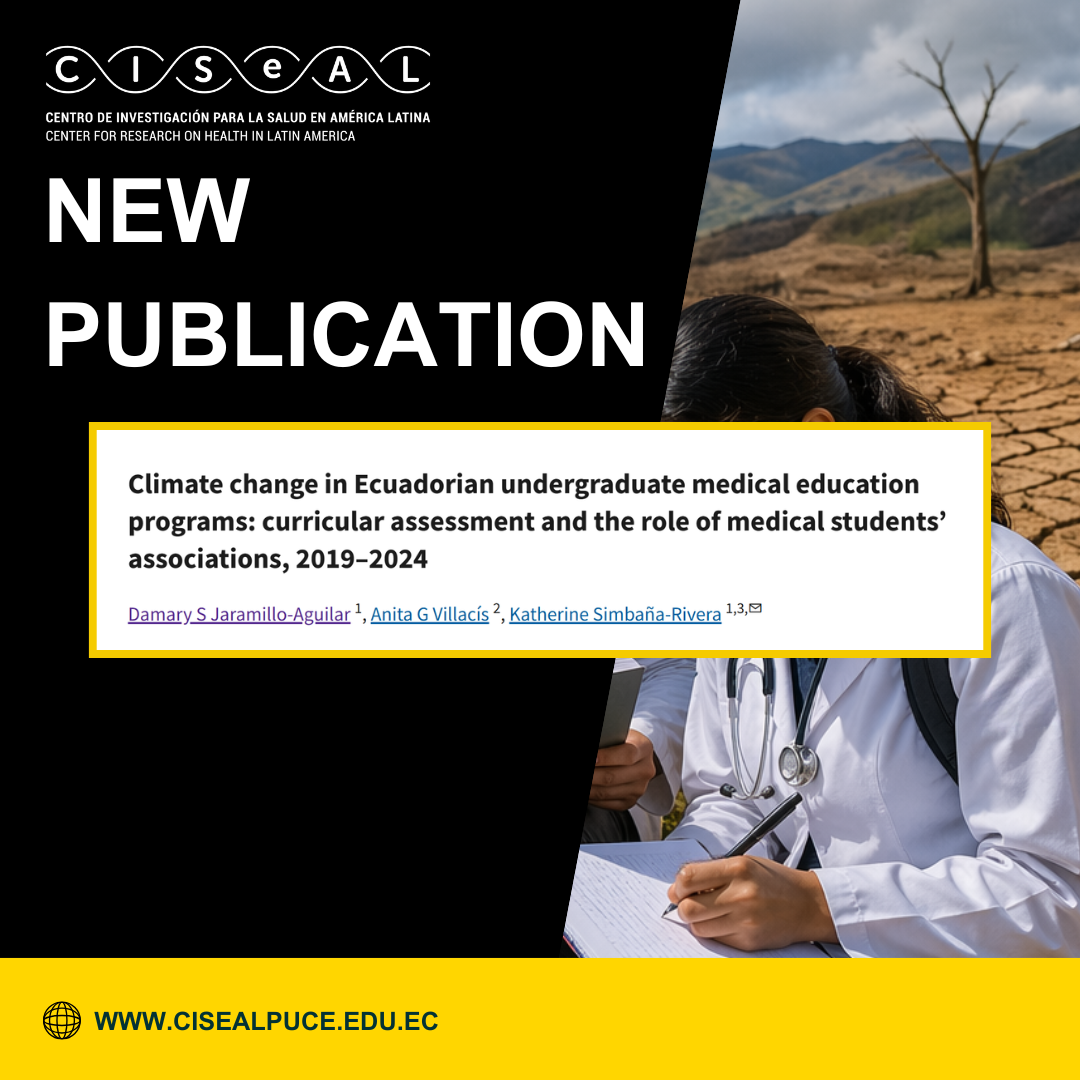
 Climate change has become established as one of the main challenges for global public health, with growing impacts on health systems and an urgent demand for trained professionals to address them. In this context, the study analyzes how undergraduate medical training programs in Ecuador have incorporated (or not) this topic between 2019 and 2024, as well as the role that student associations have taken on in addressing these gaps. With the participation of our CISeAL researchers, Damary Jaramillo-Aguilar, Anita G. Villacís, and Katherine Simbaña-Rivera, it is evident that, despite international and national recognition of the relevance of climate change, its integration into medical education remains limited, fragmented, and mostly indirect.
Based on a descriptive analysis of accredited programs and student activities, the findings show that fewer than half of the programs include related courses, and in very few cases is climate change explicitly addressed, even being reduced to isolated sessions within broader courses. This weak incorporation contrasts with the country’s high vulnerability to climate-related phenomena and their effects on communicable and non-communicable diseases, as well as on the social determinants of health. Consequently, this highlights a disconnect between the needs of the national context and the training of future health professionals, limiting their ability to anticipate, prevent, and respond to these challenges.
In response to this structural absence, medical student associations have taken on an active role, leading initiatives in awareness, education, and community action, especially during and after the COVID-19 pandemic. These activities, although valuable, are mainly developed outside the formal curriculum and lack institutional support, reflecting both student commitment and the lack of articulation with universities. This scenario suggests that the push toward a medical education more aligned with climate challenges is emerging from the student level, but has not yet become an academic priority.
The study highlights the urgent need to integrate climate change in a transversal and structured way into curricula, promoting interdisciplinary approaches, systemic thinking, and practical competencies oriented toward mitigation and adaptation. It also emphasizes the importance of strengthening collaboration between universities and student organizations to enhance the educational and social impact of these initiatives. In a megadiverse and highly vulnerable country like Ecuador, training health professionals with a comprehensive understanding of climate change is not only an opportunity but an unavoidable responsibility.
Are we truly preparing future physicians to face the health impacts of climate change? We invite you to read the full article to explore these findings and their implications at the following link: