


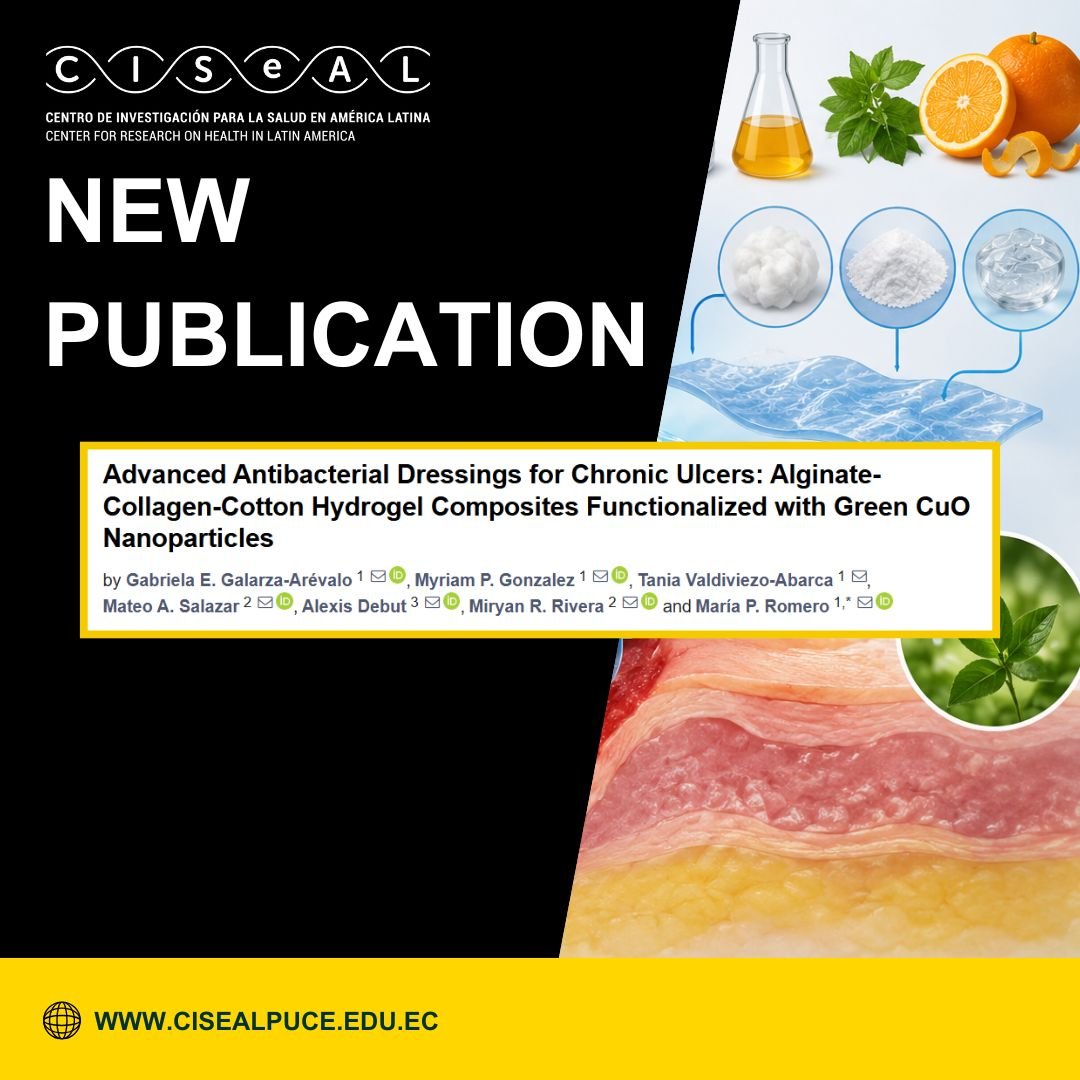
 Chronic ulcers represent a healthcare challenge due to their prolonged healing process, recurrence, and frequent microbial colonization. In this context, a study involving our researchers Miryan Rivera and Mateo Salazar, both members of the Amphibian Cytogenetics and Biomolecules Research Laboratory (LICBA)—a laboratory that is part of CISeAL—explored the development of advanced antibacterial dressings for the management of this type of wounds. The article presents the creation of sodium alginate and collagen-based hydrogel dressings, reinforced with cotton and functionalized with copper oxide (CuO) nanoparticles obtained through a green synthesis process using gallic acid and orange peel extract. The proposal seeks to integrate high exudate absorption capacity, mechanical stability, and localized antibacterial activity into a single material. Among the formulations analyzed, the one composed of 2% sodium alginate, 0.5% collagen, and 2.5% glycerin exhibited an absorption capacity of 476.82 ± 3.80% and a tensile strength of 148.7 ± 5.5 N, characteristics that led to its selection as the matrix for the incorporation of the nanoparticles.
Meanwhile, the CuO nanoparticles showed antibacterial activity against Staphylococcus aureus and Escherichia coli, with a reduction in bacterial viability of 96.6% and 91.44%, respectively, after 72 hours at a concentration of 70 µg/mL. Upon incorporation into the dressing, the antibacterial activity exhibited concentration-dependent behavior and was greater against S. aureus. These results demonstrate the potential of combining biomaterials, nanotechnology, and green synthesis processes to develop materials aimed at the localized control of microorganisms in chronic wounds. However, the study notes the need for additional research on copper ion release, the cytocompatibility of the finished dressing, its behavior under physiological conditions, and its efficacy against biofilms before moving toward eventual clinical application. What possibilities does this combination of biomaterials and nanotechnology open up for the development of new solutions against chronic wounds? Discover the full results and analysis in the article available at the link:
https://www.mdpi.com/1999-4923/18/9/1139