CISeAL - PUCE
  • Home
  • About Us
    • Our History
    • Our Vision
    • Our Mission
    • Structure
      • Support Units
      • Organization chart
      • Infrastructure
    • Services
    • Directory
    • Work with us
      • Biodiversity Researcher
    • Gallery
  • Research
    • Researchers
      • Principal investigators
      • Associate Investigators
      • Adjunct Investigators
      • Visiting Researchers
    • Research groups
    • Research Areas at CISeAL
    • Collaborative Research
    • Healthy Living Initiative
    • Infectious and Chronic Diseases Information
    • Repository
  • Education
    • Internships at CISeAL Laboratories
    • Field Research and Service Learning Summer Experience
    • Scientific Congresses and Seminars
  • News
  • Contact
  • BIOSAG
    • 2026
      • Información General
      • Comité científico
      • Conferencistas Magistrales
      • Programa Científico
      • Postulación de Simposios
      • Postulación de Trabajos libres
      • Inscripciones
      • Apoyo Institucional
      • Auspicios
      • Contacto

Select your language

  • Español (España)
  • English (UK)
  1. You are here:  
  2. Home
  3. News

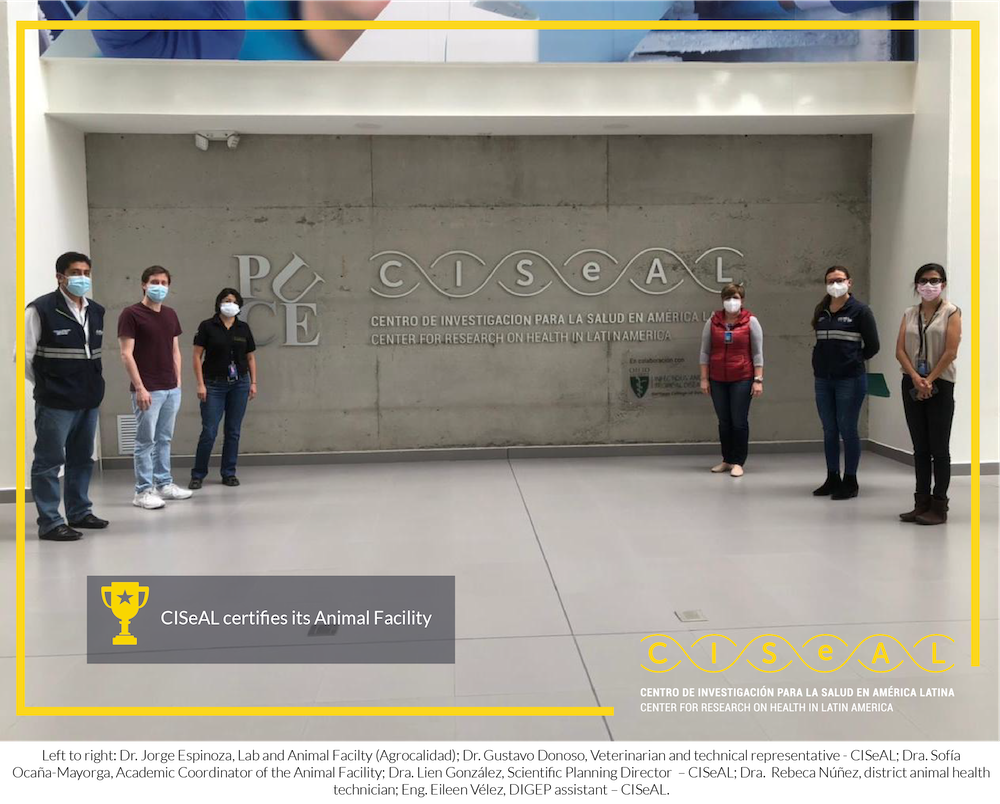
CISeAL certifies its Animal Facility

May 2021


Nota bioterio eng V1 CH 04


The Center for Research on Health in Latin America (CISeAL) of the Pontificia Universidad Católica del Ecuador (PUCE) is delighted to share with the scientific community that our Animal Facility (AF) obtained its certification as a quarantine facility by the Agencia de Regulación y Control Fito y Zoosanitario – AGROCALIDAD (national authority in charge of phytosanitary and xoosanitary control).

Read more …

Biología y distribución de vectores transmisores de malaria

En esta primera entrega de Investigaciones actuales, les presentamos un breve resumen del trabajo de nuestra investigadora principal y docente de la PUCE, Sofía Ocaña-Mayorga PhD.

IA SO3


Desde hace algunos años, en el laboratorio de la Dra. Sofía Ocaña-Mayorga se estudian la distribución y las características biológicas de los insectos implicados en la transmisión de la malaria, enfermedad parasítica que se transmite por medio de animales y que puede llegar a ser letal de no ser tratada.

Read more …

New article: Biosafety at Home

Biosafety at Home: How to Translate Biomedical Laboratory Safety Precautions for Everyday Use in the Context of COVID-19


Captura de Pantalla 2020 07 01 a las 11.24.24


Read more …

COVID-19: Manejo de datos para superar una crisis

Entrevista con César Yumiseva Mtr.

Docente investigador de la Pontificia Universidad Católica del Ecuador.

Encargado de la Unidad de Manejo de Datos del Centro de Investigación para la Salud en América Latina.


CY1


¿Por qué es importante tener un plan de manejo de datos?


El manejo de datos es uno de los asuntos más discutidos en el proceso de transformación digital. Su relevancia se ha visualizado mejor a raíz del contexto actual, en el que diferentes países enfrentan la pandemia y toman decisiones a partir de los datos epidemiológicos que recogen.

Tener un Plan de Manejo de datos resulta de la capacidad de organizar y preparar datos, aunque estos provengan de diferentes fuentes, para usarlos en beneficio de actividades y objetivos que nos conducen a la toma de decisiones frente a diferentes problemáticas. Anteriormente las bases de datos solo existían para almacenar, hoy son fundamentales para generar ciencia de datos, en donde se pueden mezclar conocimientos humanos y artificiales para clarificar el panorama dentro de procesos de toma de decisiones. De ahí la importancia de tener un verdadero Plan de Manejo de Datos, ya que este proceso es el que permite determinar qué datos son los que se necesitan y cómo estos, luego de pasar por diferentes niveles de control de calidad, nos permiten tener la “película” clara para poder actuar de manera eficiente y eficaz.

Read more …

Perfil: Dra. Jenny Tellería

Por: Jordan Puckett Ramírez

Jenny Telleria

Dra. Jenny Tellería

Jenny Tellería supo que quería ser científica desde que los vio representados por primera vez en dibujos animados con el cabello quemado después de intentar un experimento.  Desde entonces, esta destacada científica boliviana ha recorrido un largo camino hasta su investigación actual: la enfermedad de Chagas, que aunque a menudo ignorada, puede ser mortal y afecta a gran parte de América Latina, incluido su país de origen.

Read more …

Green synthesis of silver nanoparticles using Solanum mammosum L. (Solanaceae) fruit extract and their larvicidal activity against Aedes aegypti L. (Diptera: Culicidae)

 Artículo MN1

Fig 1. Solanum mammosum (L.) botanical voucher.


Pilaquinga F, Morejón B, Ganchala D, Morey J, Piña N, Debut A, Neira M. (2019) Green synthesis of silver nanoparticles using Solanum mammosum L. (Solanaceae) fruit extract and their larvicidal activity against Aedes aegypti L. (Diptera: Culicidae). PLoS ONE 14(10): e0224109

This article is the result of a multi-disciplinary collaboration between PUCE's Nanotechnology Laboratory, the Center for Research on Health in Latin America (CISeAL), Spain's University of the Balearic Islands and the Center for Nanosciences and Natotechnology at the Ecuadorian Armed Forces University (ESPE). In the manuscript, authors Ma. Fernanda Pilaquinga, Bianca Morejón et al. detail the preparation and characterization of silver nanoparticles synthetized using a "green chemistry" method that uses an extract obtained from the fruits of Solanum mammosum (a plant native to the andean and coastal areas of Ecuador), as well as the evaluation of said particle's insecticidal activity against the mosquito Aedes aegypti, the main vector of diseases such as dengue, Zika and chikungunya around the world.

The results presented show that both the pure S. mammosum extract and the nanoparticles coated with said extract exhibited measurable insecticidal activity. However, the nanoparticles (which were prepared using an easy, cheap and environmentally friendly method) presented an increase in efficiency of approximately 25,000 fold compared to the extract alone.

These results suggest that both S. mammosum and the nanoparticles coated with its extract have the potential to be developed as novel control tools against one the most important species of insect vector of human disease, and possibly against other insect species of major medical and economic relevance.

Read the full article:  https://journals.plos.org/plosone/article?id=10.1371/journal.pone.0224109#pone-0224109-g005

Page 14 of 17

  • 8
  • 9
  • 10
  • 11
  • 12
  • 13
  • 14
  • 15
  • 16
  • 17
  • Home
  • About Us
    • Our History
    • Our Vision
    • Our Mission
    • Structure
      • Support Units
      • Organization chart
      • Infrastructure
    • Services
    • Directory
    • Work with us
      • Biodiversity Researcher
    • Gallery
  • Research
    • Researchers
      • Principal investigators
      • Associate Investigators
      • Adjunct Investigators
      • Visiting Researchers
    • Research groups
    • Research Areas at CISeAL
    • Collaborative Research
    • Healthy Living Initiative
    • Infectious and Chronic Diseases Information
    • Repository
  • Education
    • Internships at CISeAL Laboratories
    • Field Research and Service Learning Summer Experience
    • Scientific Congresses and Seminars
  • News
  • Contact
  • BIOSAG
    • 2026
      • Información General
      • Comité científico
      • Conferencistas Magistrales
      • Programa Científico
      • Postulación de Simposios
      • Postulación de Trabajos libres
      • Inscripciones
      • Apoyo Institucional
      • Auspicios
      • Contacto
In Collaboration With Ohio University - Infectious and Tropical Disease Institute
PUCE
  • PUCE Research Office
  • School of Biological Sciences
  • Faculty of Exact and Natural Sciences - PUCE
  • School of Medicine
  • School of Nursing
Ohio University
  • Infectious and Tropical Disease Institute - Ohio University
  • STARS - Ohio University
  • Riding Against Chagas

PUCE | CISEAL
Copyright © 2026. CISeAL - PUCE.
  • Home
  • About Us
    • Our History
    • Our Vision
    • Our Mission
    • Structure
      • Support Units
      • Organization chart
      • Infrastructure
    • Services
    • Directory
    • Work with us
      • Biodiversity Researcher
    • Gallery
  • Research
    • Researchers
      • Principal investigators
      • Associate Investigators
      • Adjunct Investigators
      • Visiting Researchers
    • Research groups
    • Research Areas at CISeAL
    • Collaborative Research
    • Healthy Living Initiative
    • Infectious and Chronic Diseases Information
    • Repository
  • Education
    • Internships at CISeAL Laboratories
    • Field Research and Service Learning Summer Experience
    • Scientific Congresses and Seminars
  • News
  • Contact
  • BIOSAG
    • 2026
      • Información General
      • Comité científico
      • Conferencistas Magistrales
      • Programa Científico
      • Postulación de Simposios
      • Postulación de Trabajos libres
      • Inscripciones
      • Apoyo Institucional
      • Auspicios
      • Contacto